Beyond the Headlines: Why China Remains the Safest Haven for Your Supply Chain
In this turbulent spring of 2026, the nerves of global trade are tightly wound around the narrow waters of the Persian Gulf. As the conflict between the US and Iran escalates rapidly, the Strait of Hormuz has once again become the “Ground Zero” of geopolitical tension. As the only maritime passage connecting the Persian Gulf to the Indian Ocean, this chokepoint handles approximately 20% – 30% of the world’s oil trade (International Energy Agency, 2023).
For global e-commerce sellers, retailers, and wholesalers, this is not just a war in the news; it is an imminent supply chain crisis. The surge in sea freight prices, the delay of vessel schedules, and the skyrocketing insurance premiums are turning “shipping from China” into a high-risk gamble.
At this critical juncture, as a professional Yiwu Agent with over 20 years of deep cultivation in the Yiwu market, I am not only monitoring the news but also seeking a survival path for my clients. This article will, based on the latest battle data (as of March 28, 2026), deeply analyze the actual impact of this crisis on Yiwu Logistics and provide you with a practical solution based on “Multi-Supplier Consolidation.”
The Real Impact on Yiwu Logistics
Many people believe that the war between Iran and Israel is far away from Yiwu. However, as an expert who has been struggling in the industry for many years, I know clearly that the connection between the two is much closer than you think.
The “Roller Coaster” Market of Freight Rates
Under the current situation, all ships heading to Europe or the US East Coast via the Suez Canal and the Red Sea must face huge risks. Although the Strait of Hormuz itself mainly affects the eastward transportation of oil to Asia, it has formed a “dual squeeze” with the Red Sea crisis (Houthi attacks).
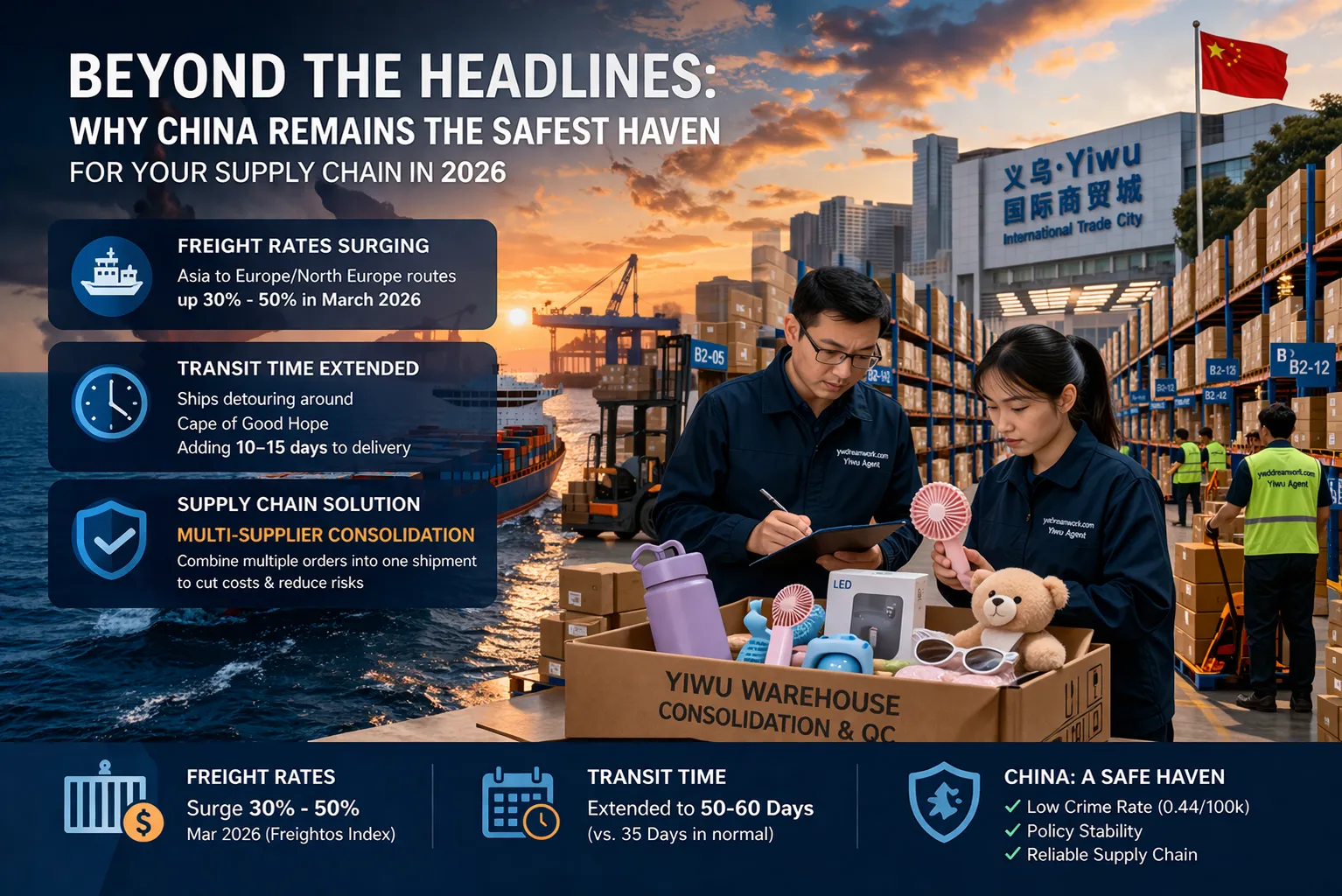
- Data Support: According to the latest data from the Freightos Baltic Index, freight rates on the Asia to Mediterranean/North Europe routes have seen an abnormal surge of 30%-50% in March 2026.
- Expert Insight: In my Yiwu Warehouse, I have witnessed with my own eyes that many clients’ goods are piling up due to the inability to confirm vessel schedules. The traditional “Sea Freight + Express” model is failing.
Uncertainty of Transit Time
In peacetime, shipping from Yiwu to Europe and America usually takes 25-40 days. However, under the current situation, ships have to detour around the Cape of Good Hope to avoid risks. This has increased the voyage by 10-15 days or even more. For sellers relying on seasonal sales (such as summer toys and gifts), this means missing the entire sales season.
Core Strategy: Why “Multi-Supplier Consolidation” is the Survival Law in 2026
Faced with high freight costs and long transit times, as a shrewd buyer, your only way out is to “huddle for warmth.” This is why I strongly recommend that my clients adopt the Multi-Supplier Consolidation model in 2026.
What is Multi-Supplier Consolidation?
In Yiwu, an order often involves dozens or even hundreds of different small commodity markets (accessories, toys, home furnishings, etc.). If you ship separately from these 100 suppliers, you need to pay 100 times the high freight, and each shipment faces the risk of customs inspection.
- My Solution: My team will help you merge these 100 packages into 1 large package in the Yiwu Warehouse. You only need to pay 1 freight, but it contains all the goods.
Cost-Benefit Analysis
Under the current situation of doubled freight, the advantages of consolidation are magnified several times.
- Space Saving: Through professional repacking and removing excess packaging, we can save 15%-20% of the volume for your goods.
- Freight Saving: The unit price of Full Container Load (FCL) or Less than Container Load (LCL) is much lower than that of scattered parcels.
- Risk Reduction: The risk of losing 1 package is much lower than losing 100 packages.
Quality Control & Trust
Under the shadow of war, the cost of trust is extremely high. You cannot fly to Yiwu to inspect the goods of every supplier. As your Quality Control representative, I will conduct a 100% unpacking inspection of all consolidated goods before shipment. This not only prevents passing off inferior goods as good ones but also ensures that you do not pay high war premium freight for wrong goods.
Alternative Plans: What Other Routes Do We Have?
Although the Strait of Hormuz is the oil throat, the export of Chinese goods has more diversified paths. According to my years of experience, when the sea route is blocked, we have the following alternative plans:
- China-Europe Railway Express: This is currently the most stable land channel. Although it does not pass through the Middle East, it is less affected by geopolitics. It is faster than sea freight (15-20 days) and cheaper than air freight.
- China-Laos Railway & Southeast Asia Channel: Transport goods by rail to Laos and Thailand, then transfer to sea freight. This is a “flanking tactic” that avoids the Red Sea and the Strait of Hormuz.
- Air Freight & Express Combination: For high-value, lightweight goods, take advantage of Yiwu’s air port advantages and adopt an “Air Freight + Domestic Delivery” model in the destination country.
Finding Certainty: Why China Remains the Safest Haven
While the world is turbulent, it is crucial to recognize that China remains one of the safest countries in the world, providing a stable “ballast stone” for the global supply chain.
According to the Gallup Global Safety Report 2025, China ranks among the highest globally for resident safety and the rule of law, far exceeding many Western developed nations.
- Safe for Business Travel: Whether it’s the night market in Yiwu or the streets of Guangzhou, walking alone late at night is normal—a luxury unimaginable in many other countries.
- Asset Security: Our clients are often amazed that phones or laptops left on restaurant tables in China are often still there waiting for the owner.
- Low Crime Rate: China is one of the countries with the lowest homicide rates in the world (only 0.44 per 100,000 people), providing the most solid environment for your business trips and cargo storage.
Supply Chain Security: More Precious than Goods is “Trust”
For cross-border e-commerce, “safety” means two things: cargo safety and policy safety.
- Policy Stability: Unlike the “flip-flop” policy changes in some countries, China’s business environment policies have high continuity and predictability.
- Infrastructure Resilience: Our logistics network (roads, railways, ports) maintains amazing resilience even under extreme weather or global turmoil. When you place an order in Yiwu, the goods move like clockwork.
Conclusion: Building Resilience in Turbulence
The beginning of 2026 is turbulent, but for sellers who know how to use the advantages of the Yiwu Market, there are opportunities in the crisis. Through Multi-Supplier Consolidation, you can transform high logistics costs into competitive advantages; through professional Sourcing Agents, you can minimize geopolitical risks.
Do not let the artillery fire of the Strait of Hormuz sink your business. In Yiwu, we have an old saying: “There are more ways than difficulties.” Utilizing the Global Shipping Solutions I provide, we can sail through this storm together.
Frequently Asked Questions (FAQ)
Q1: Will the conflict in the Strait of Hormuz directly cut off cargo ships from Yiwu to the US?
A: No, it will not be directly cut off, as container ships from Yiwu to the US usually take the Pacific route, which does not pass through the Persian Gulf. However, this conflict will lead to a global shortage of shipping capacity and rising fuel prices. More importantly, combined with the Red Sea crisis, it forces many ships to detour around the Cape of Good Hope, slowing down the global fleet turnover and ultimately leading to a shortage of booking space or a surge in freight rates.
Q2: Will my goods be seized in Yiwu during the war?
A: Absolutely not. Yiwu is an inland city in China, hundreds of kilometers away from the coast, and is in an absolute safe zone. All Logistics Operations are conducted within China and are not affected by the fires of war in the Middle East. Your goods are 100% safe in our Yiwu Warehouse.
Q3: What is “Multi-Supplier Consolidation,” and why does it save money?
A: Simply put, it means sending all the scattered goods you bought in the Yiwu market to our warehouse first. We help you pack them into one large box to send to you. In times of high freight, the cost of sending 1 large box is much lower than sending 10 small packages. Additionally, we can help you remove excess packaging boxes, directly saving you 15%-20% on freight.
Q4: How long does it take to ship to Europe now?
A: Under normal circumstances, it takes about 35 days. However, due to the current situation, many shipping companies have chosen to detour to avoid risks. Therefore, the current estimated transit time may be extended to 50-60 days. If you have urgent orders, I strongly recommend using the China-Europe Railway (18-22 days) or air freight services.
Q5: How can I trust the Quality Control (QC) you do in Yiwu?
A: We provide a fully visualized service. Our Sourcing Team will provide you with unpacking videos and high-definition photos of each batch of goods. Furthermore, with over 20 years of industry experience, our reputation is built on client trust. You can request a video call at any time to view the goods in the warehouse in real-time.
Reference List
International Energy Agency. (2023). Oil Market Report. https://www.iea.org/reports/oil-market-report
Gallup. (2025). Global Safety Report 2025. https://www.gallup.com
World Trade Organization. (2024). World Trade Statistical Review. https://www.wto.org
Freightos. (2026). March 2026 Freight Index Report. https://www.freightos.com
Ministry of Public Security of China. (2025). Statistics on Criminal Cases and Public Security.